
What you will make
A flower of six petals round a hub, and a leaf made from half of one, as two halves that meet along a straight edge. Turn Copies… copies any object, a plate, a wire or a ring, turned about a place you choose. Count counts the original too: Count 6 is the original and five copies. Mirror Line from Selection keeps one straight edge of a mesh as a mirror line, so that Mirror can swap the two sides of that edge. A jeweller draws half a leaf, a petal or a drop, and lets the add-on make the rest at the angles and the edge that fit. The pieces stay separate objects here: to cast the flower or the leaf as one body they must be joined, which this page does not do. The pivot point (the point a rotation turns about) and the 3D cursor are not touched by either tool.
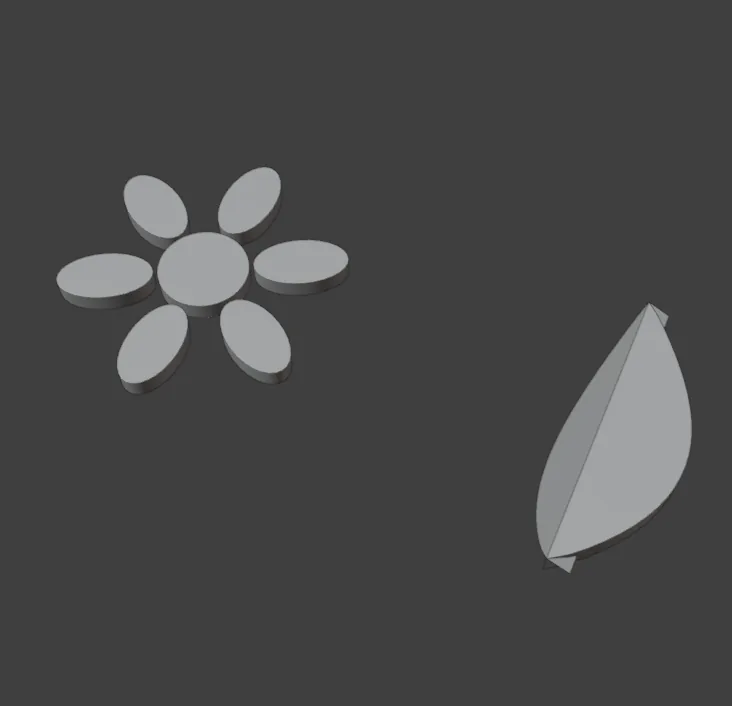
About 10 minutes.
Files
- p3-13-start.blend (104 KB): open this one to begin.
- p3-13-finished.blend (112 KB): the result, to compare with yours.
Both were made in Blender 5.2.0.
Before you start
- You have done Part 0, and you know how to mirror an object with
Alt+M(Mirror any object about a place you choose, P3-12). The start file holds a hub, a petal and half a leaf, in millimetres. - CAD/CAM Jeweller 2.22.0 or later is installed (Preferences > Add-ons shows the version), and its CAD/CAM tab is in the sidebar.
Build it
Step 1. Open the start file and save your copy
WhereThe top bar: the row of words that begins File, Edit.
DoDownload p3-13-start.blend from Files above and open it. Then choose File > Save As and save it under the name below, in a folder of yours. Open an exercise file and keep the start file safe (P0-07) shows how.
Typemy-leaves.blend
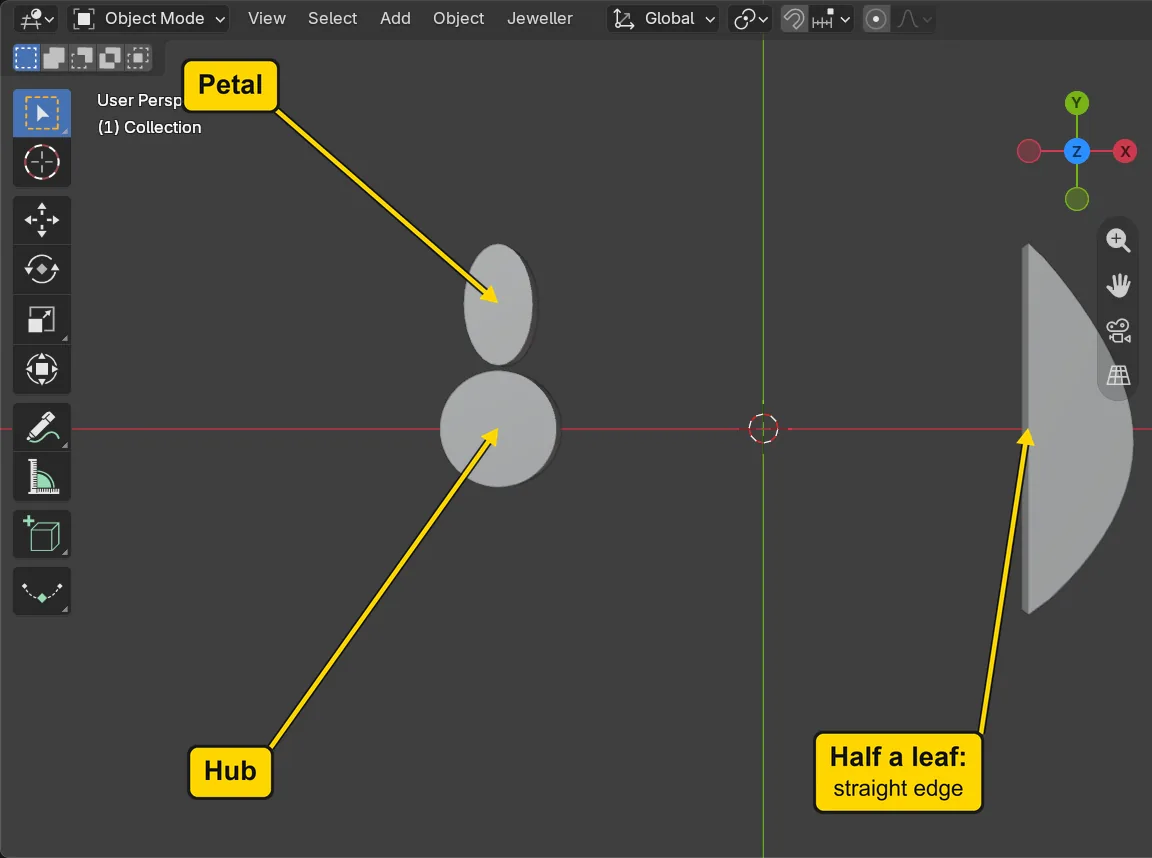
You should seeThe 3D view looks straight down at a small round hub with one petal above it, at the left, and at the right half a leaf: a long pointed shape with a straight left edge. The Outliner, the list at the top right of the window, holds Hub, Petal and Leaf. To look straight down at any time, click the blue Z ball of the gizmo, the small ball of coloured letters at the top right of the 3D view.
It worked whenThe title bar, the strip above File and Edit, begins my-leaves.
Step 2. Pick the petal, then the hub
WhereThe 3D view.
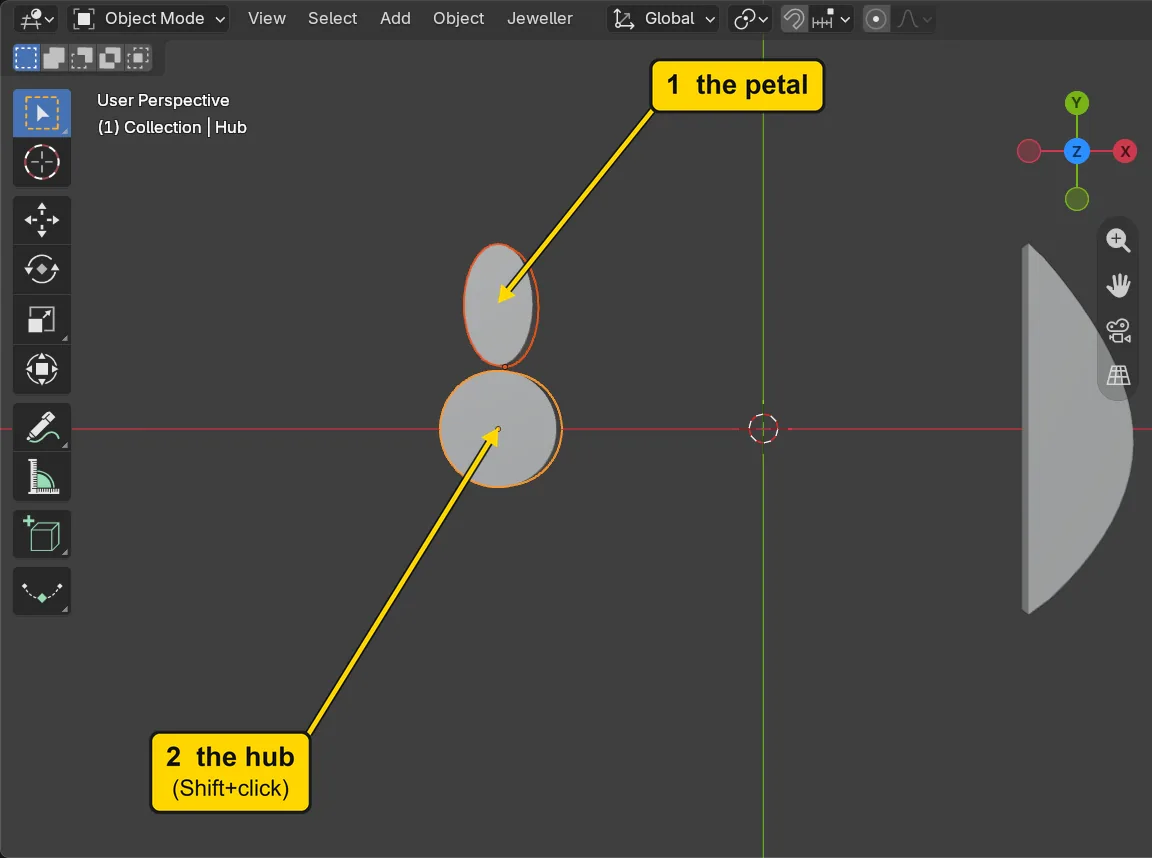
DoClick the petal, then hold Shift and click the hub.
You should seeBoth orange, the hub a lighter orange: it is the active object, the last one you clicked. The petal is what the copies are made of. The hub is the place they turn about, so you pick it last.
It worked whenThe words at the top left of the 3D view name the hub.
Step 3. Open the Turn Copies window
WhereThe sidebar, the CAD/CAM tab. If the sidebar is shut, press N with the pointer over the 3D view. Click Mirror in the section bar, the small word buttons at the top. The Mirror and Copy panel is the second panel of the section.
DoPress Turn Copies….
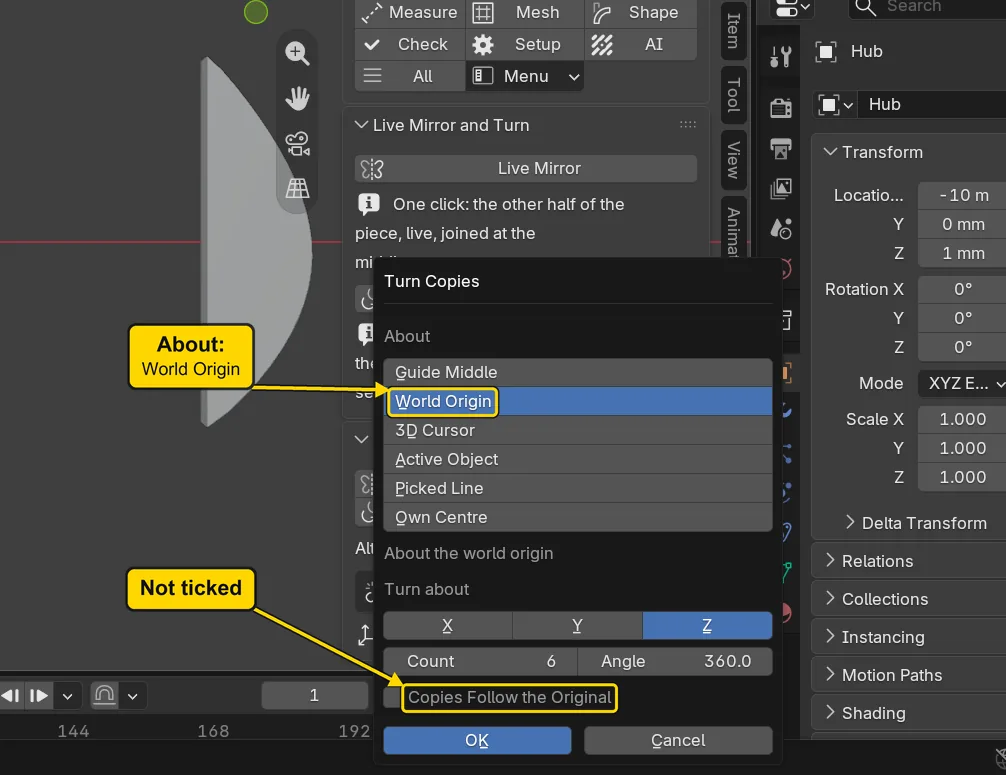
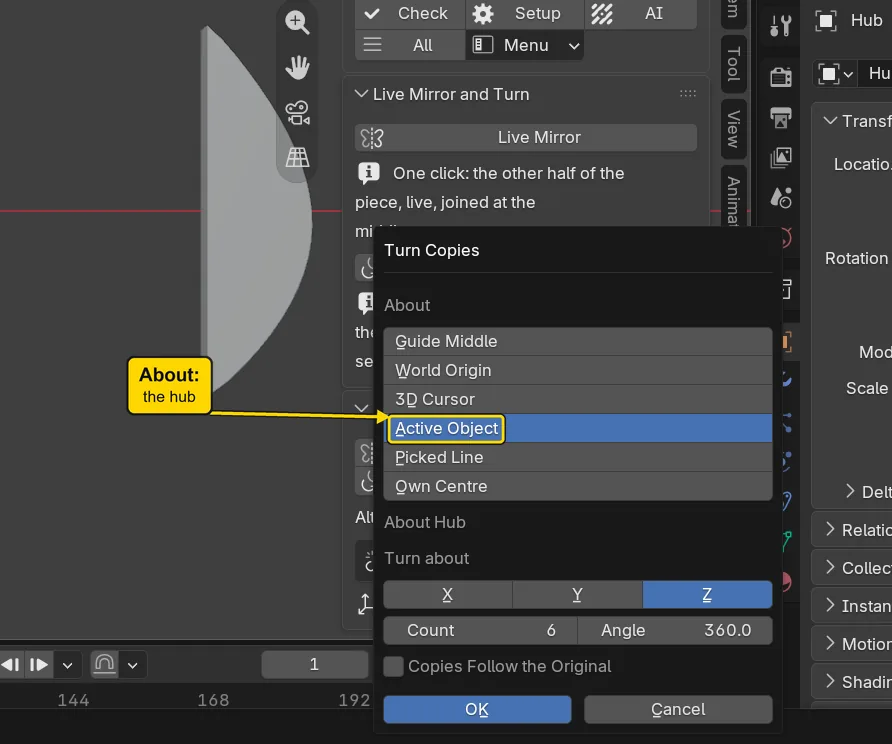
You should seeA window headed Turn Copies opens over the sidebar. About is a list of six places to turn about (the table says what each is), and World Origin is lit: that is the world’s middle, far from this flower. Under it stand Turn about with X, Y and Z (Z is lit), Count 6, Angle 360 and the box Copies Follow the Original, not ticked. They are the add-on’s starting numbers. Count counts the original too: Count 6 is the original and five copies.
It worked whenA window headed Turn Copies stands open over the sidebar.
| About | What the copies turn about |
|---|---|
| Guide Middle | the middle of the Flow guide on a band, 12 o’clock |
| World Origin | the world origin and the world axes |
| 3D Cursor | where the 3D cursor stands now: it is not moved |
| Active Object | the centre and axes of the object clicked last: it is the reference and is not copied |
| Picked Line | a mirror line set from an edge in Edit Mode |
| Own Centre | the middle of what is selected |
Step 4. Choose Active Object
WhereThe Turn Copies window: the list under About.
DoClick Active Object.
You should seeThe list now has Active Object lit, and a line under it names the hub: the copies will turn about the hub’s middle. World Origin would have turned them about the world’s middle, six petals round the wrong place.
It worked whenActive Object is lit and a line under the list names the hub.
Step 5. Press OK
WhereThe Turn Copies window: the button OK at its foot.
DoPress OK.
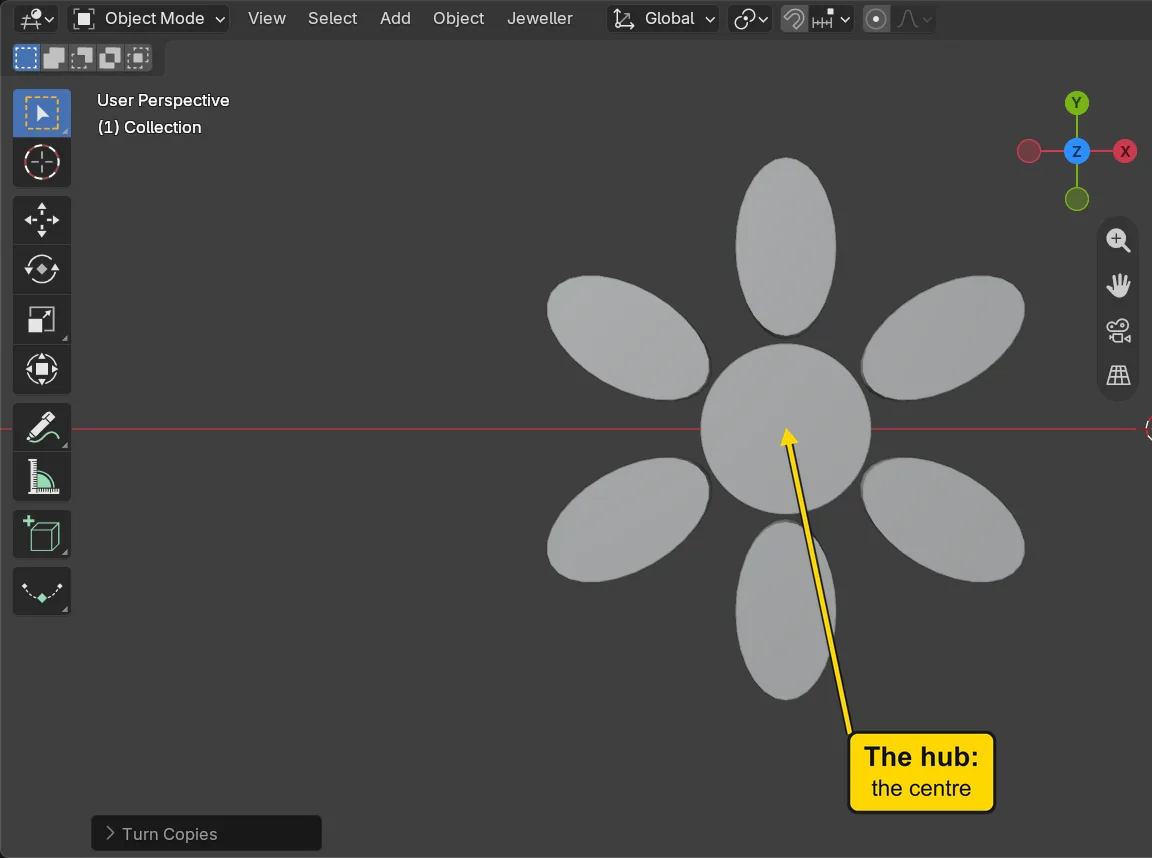
You should seeFive more petals round the hub: six petals in all, the one you picked and five copies, 60 degrees apart. The window shut, and the five copies are selected. The status bar, the line along the very bottom of the window, says for a moment “5 copies turned about Hub, axis Z, 60.0 degrees apart”.
It worked whenSix petals stand evenly round the hub.
Step 6. Go into Edit Mode on the leaf
WhereThe 3D view. Move the pointer over the dark area.
DoClick the leaf, then press Tab.
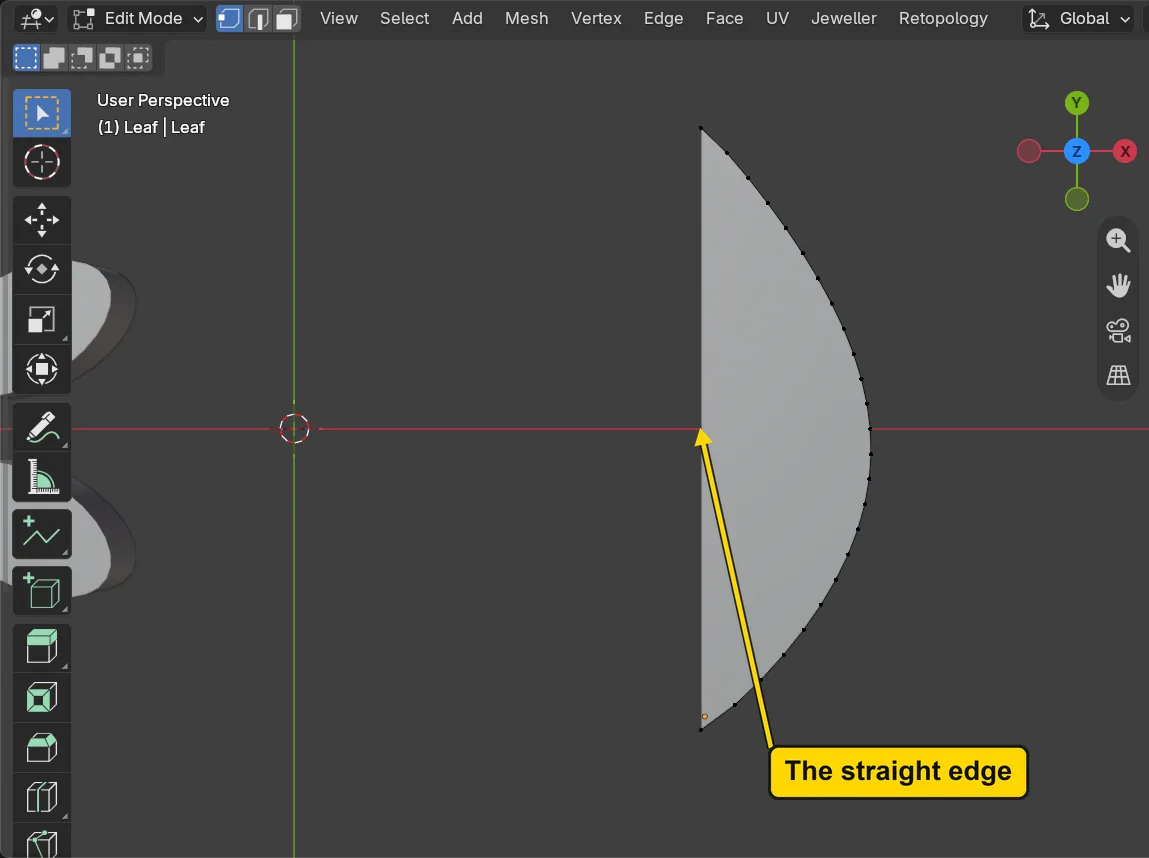
You should seeThe words at the top left of the 3D view name the leaf and the header reads Edit Mode. The leaf shows its points and lines. Edit Mode is where you pick a point or an edge.
It worked whenThe header reads Edit Mode.
Step 7. Pick the straight edge
WhereThe 3D view, in Edit Mode.
DoPress 2 on the number row, the keys above the letters, then click the middle of the straight edge.
Type2
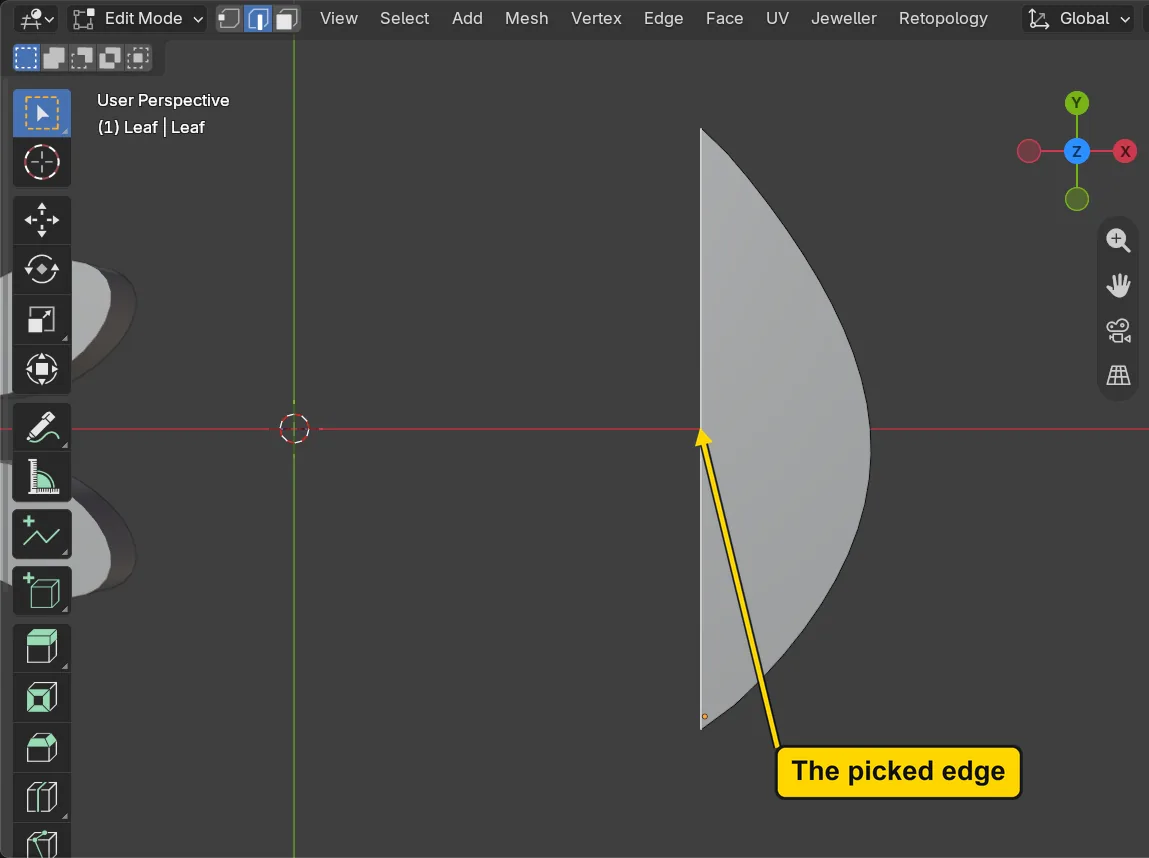
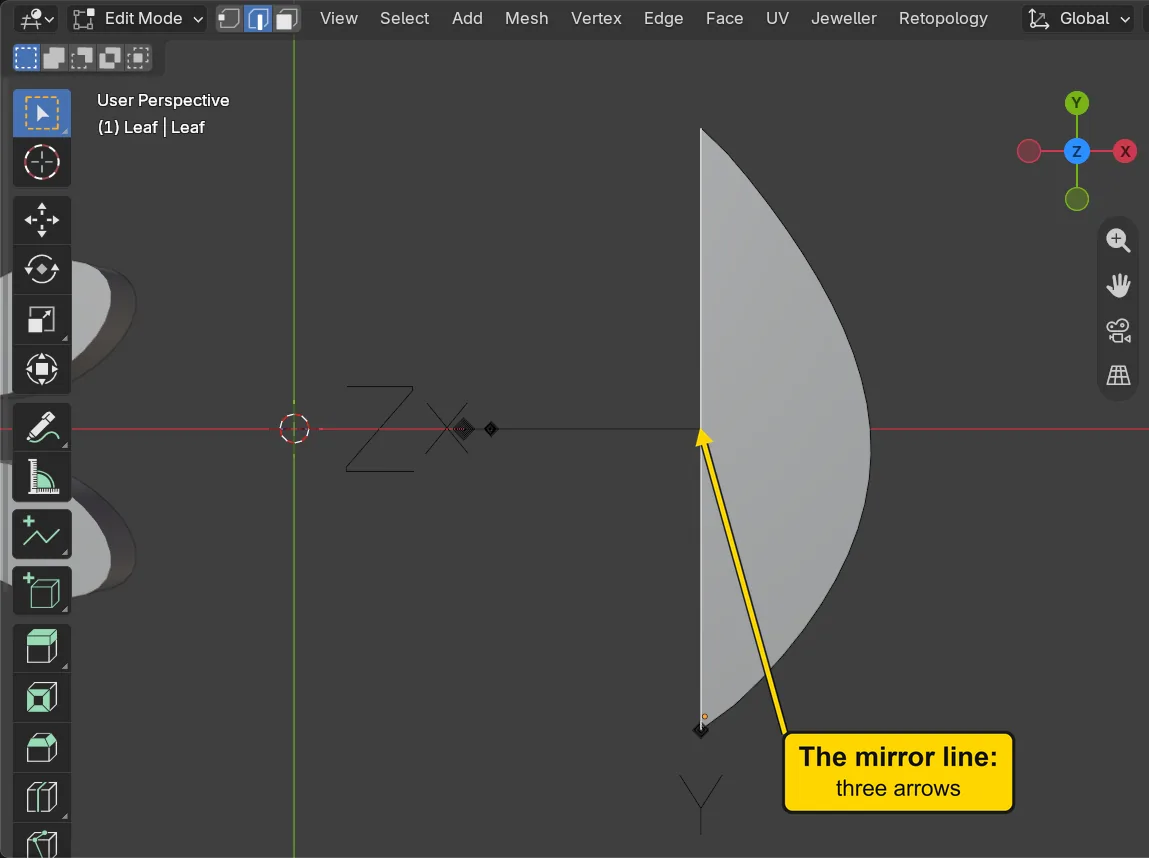
You should seeOne edge lit: the long straight edge of the leaf shows as a pale, nearly white line, the colour Blender gives the edge you picked last, with a small orange dot at one end. 2 on the number row chooses edge picking, so a click picks a whole edge and not a point. A different key on the number pad would turn the view instead.
It worked whenThe long straight edge shows as a pale, nearly white line.
If it goes wrongThe view turns: The key was on the number pad. Press 2 on the number row, the keys above the letters.
Step 8. Press Mirror Line from Selection
WhereThe Mirror and Copy panel. In Edit Mode it holds one line of words, Pick an edge, or two points, and one button.
DoPress Mirror Line from Selection.
You should seeA small object, CJ Mirror Line, drawn as three thin arrows marked X, Y and Z at the edge. X is the way a mirror goes across the line. The status bar says “Mirror line set” with the edge’s length for a moment.
It worked whenThree thin arrows marked X, Y and Z stand at the straight edge.
Step 9. Go back to Object Mode and open the Mirror window
WhereThe 3D view. Move the pointer over the dark area.
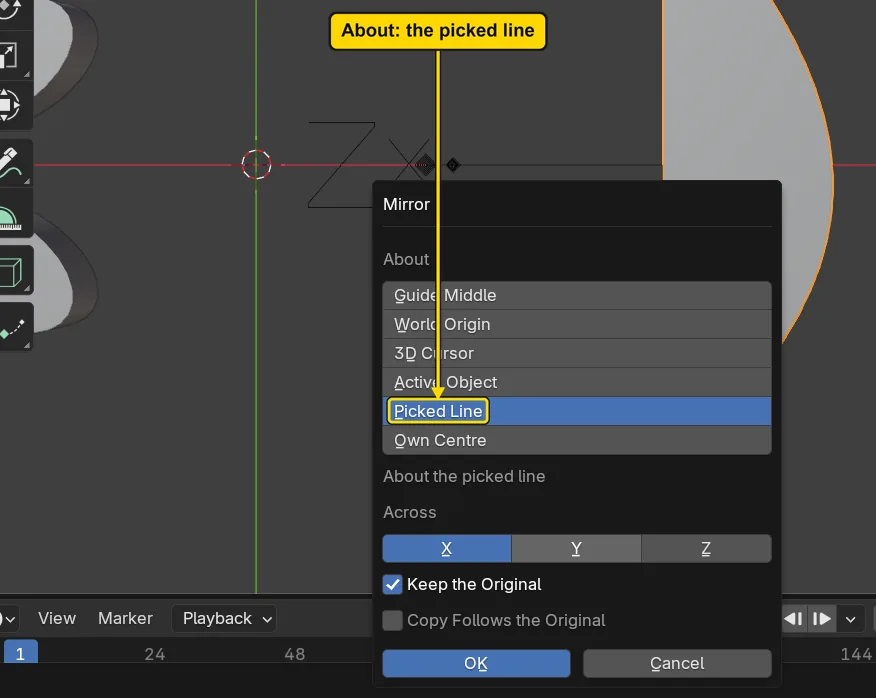
DoPress Tab, then Alt+M, then click Picked Line in the list under About.
TypeTab, Alt+M
You should seeThe header reads Object Mode and the leaf is selected. The Mirror window opens with Picked Line lit under About. Across is X: across the line, the way the arrow marked X points. Keep the Original is ticked.
It worked whenThe Mirror window shows Picked Line lit under About.
Step 10. Press OK
WhereThe Mirror window: the button OK at its foot.
DoPress OK.
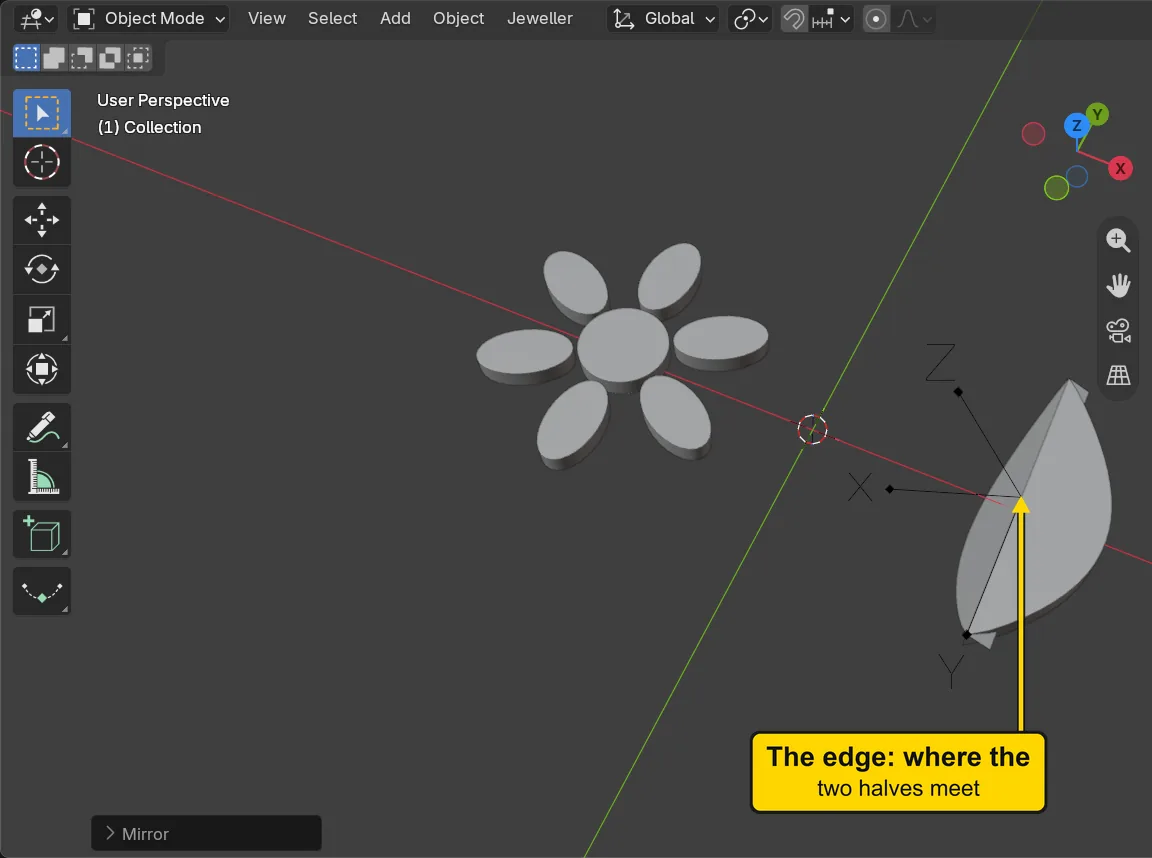
You should seeThe other half of the leaf, to the left of the straight edge: a mirror image that meets the first along the edge. They are two objects, Leaf and Leaf.001, side by side in the Outliner: the copy is a new object, and the two are not joined into one. The pivot point and the 3D cursor are as they were.
It worked whenThe other half of the leaf stands at the right of the flower, and the Outliner lists Leaf.001.
Step 11. Save your work
WhereThe 3D view: move the pointer over it.
DoPress Ctrl+S.
You should seeBlender writes your copy at once, with no question, because the file already has a name. An asterisk, *, in the title bar marks changes that are not saved, and it goes now. Save your work and get it back (P0-12) says more about saving.
It worked whenThe title bar begins my-leaves and carries no asterisk.
No picture: the only change is a message on the status bar, and it fades.
Check your result
| What to read | Where | What it should say |
|---|---|---|
| The petals | The 3D view, from above | Six petals stand evenly round the hub, the hub in the middle of them |
| A turned copy | The Item tab of the sidebar, Location:, with the petal at the bottom of the flower selected | X reads -10 mm and Y reads -2.4 mm |
| The mirror line | The 3D view, at the leaf’s straight edge | Three thin arrows marked X, Y and Z stand at the edge, the one marked X pointing across it |
| The leaf | The 3D view, from above, and the Outliner, the list at the top right of the window | The two halves meet along the edge, the new half on the left of it, and the Outliner lists Leaf and Leaf.001: two objects, not one joined body |
| The flower | The 3D view, from above, at step 5 | The six petals stand 0.20 mm clear of the hub and 1.50 mm from each other, as the picture shows: seven separate objects, not one body |
Try it yourself
Open your copy. Click the hub, press Turn Copies…, choose Active Object, type 3 in Count and 120 in Angle, and press OK: you get two turned copies of the hub, 60 degrees apart, because a count of 3 over 120 degrees spreads from the first to the last.
What you learned
- Turn Copies… turns copies of any object about the place you choose under About. Pick the object, then the object to turn about, last. Count counts the original too.
- Mirror Line from Selection keeps a picked edge as a mirror line, in Edit Mode. Back in Object Mode,
Alt+Mwith Picked Line mirrors about it. - Neither tool touches your pivot point or your 3D cursor.