

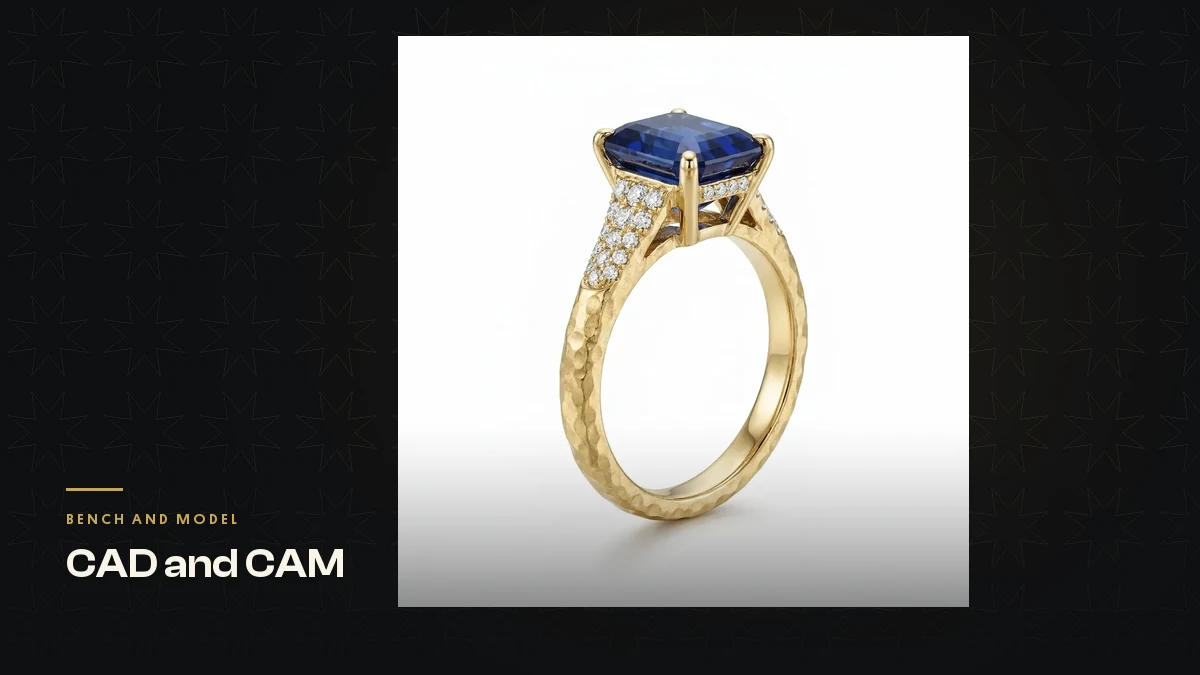
Have you ever stood mesmerised before a jewellery shop window, wondering how those intricate rings and pendants are created with such extraordinary precision? Perhaps you have admired a piece with impossibly detailed filigree work and thought: how on earth did they make that?
The answer lies in a technological revolution that has transformed this ancient craft: Computer-Aided Design and Computer-Aided Manufacturing, or CAD/CAM. As a jewellery CAD specialist who has spent years working with these technologies and training others through my book The CAD/CAM Jeweller, I am thrilled to guide you through the fascinating world of digital jewellery design and how it is revolutionising the industry.
What is CAD/CAM and How Has It Transformed Jewellery Making?
For thousands of years, jewellers worked with hand-sketches, carved wax models manually, and fabricated metal through painstaking processes. These traditional methods produced stunning pieces but had inherent limitations in terms of precision, consistency, and the complexity of designs that could be realistically achieved.
CAD (Computer-Aided Design) is the digital design component, where jewellery pieces are created virtually on a computer. CAM (Computer-Aided Manufacturing) is the production element, where these digital designs are transformed into physical objects.
The CAD/CAM process
Using specialised software like Rhinoceros (commonly known as Rhino), designers create incredibly detailed 3D digital models with precision down to fractions of a millimetre. The software allows for perfect symmetry, exact measurements, and complex geometric patterns that would be extraordinarily difficult, if not impossible, to create by hand.
- 3D printing: The digital file is sent to a high-precision 3D printer that creates a wax or resin model of the jewellery piece
- Casting: This model is then used in the traditional lost-wax casting process, where it is encased in a plaster-like material, melted away, and replaced with molten precious metal
- Finishing: The raw cast piece is finished by skilled craftspeople who polish, set stones, and add final touches
Advantages of CAD/CAM
- Unparalleled precision: Every curve, dimension, and angle can be controlled with incredible accuracy. Stone settings can be perfectly aligned, filigree work can be identically repeated, and symmetry can be mathematically perfect, all while maintaining the artistic integrity of the design
- Pre-visualisation: Photorealistic renderings of designs before production begins allow clients to see exactly what their commissioned piece will look like, making adjustments before any precious materials are used
- Efficiency and flexibility: Changes that would require starting from scratch with traditional methods can be implemented with a few clicks. Designs can be quickly modified for different stone sizes, finger sizes, or material requirements
- Complexity without compromise: CAD/CAM enables the creation of structures and details that would be extremely challenging using traditional techniques alone. Interlocking components, complex lattice structures, and mathematically precise patterns become achievable
- Customisation at scale: While bespoke jewellery has always existed, CAD/CAM makes custom design more accessible. Designs can be easily modified for individual clients while maintaining production efficiency
The Jewellery CAD Designer: Role and Career Path
A jewellery CAD designer’s day-to-day work includes:
- Creating new designs based on briefs from clients or the design team
- Modifying existing designs for different sizes or variations
- Generating photorealistic renderings for client approval and marketing materials
- Preparing files for 3D printing or manufacturing, ensuring they meet technical requirements
- Collaborating with traditional bench jewellers who will finish and set the pieces
- Researching trends and techniques to continually evolve their design capabilities
Career paths
- In-house designer: Start as junior designer at an established brand or manufacturer; progress to senior or CAD manager
- Independent designer or freelancer: Offer expertise to multiple clients
- Entrepreneur: Launch your own design studio or jewellery brand
- Hybrid craftsperson: Combine CAD with traditional bench skills
- Educator or consultant: Teach, write, or consult
Essential Software for Jewellery CAD Design
- Rhinoceros (Rhino): Industry standard. NURBS-based. Precision modelling, affordable, extensive plugin ecosystem, widespread industry adoption
- MatrixGold (Rhino plugin): Stone setting features with automated prong creation, ring sizing, weight calculations, jewellery-specific rendering, libraries of common components
- 3Design: Purpose-built jewellery CAD software. Powerful parametric modelling. Integrated gemstone libraries
- Blender: Free, open-source. Good for organic forms and sculptural elements alongside Rhino
- ZBrush: Digital sculpting. Excellent for organic, sculptural pieces
- Fusion 360 / Solidworks: Industrial design tools. Powerful parametric modelling. Suited to geometric or mechanical designs
For those entering the field, I recommend starting with Rhino for several compelling reasons. It is the industry standard, with skills highly transferable and sought after by employers. It balances precision and flexibility, handling both geometric and organic forms effectively. With plugins like MatrixGold it becomes jewellery-specific. And there is a large community of users and abundant training materials.
The Future of Jewellery CAD/CAM
- Direct metal 3D printing advancing rapidly
- AI-assisted design for generative design processes
- Virtual try-on technology via augmented reality
Conclusion
The integration of CAD/CAM into jewellery creation represents not the replacement of traditional craftsmanship but its evolution. The most successful applications of these technologies honour centuries of jewellery-making wisdom while embracing new possibilities.
For aspiring designers, learning CAD is now as essential as understanding metalsmithing principles. For established jewellers, incorporating digital workflows can expand creative horizons and production capabilities.
Remember that even the most complex digital designs begin with simple elements, and proficiency develops through practice and experimentation. The journey from novice to master is one of continuous learning, embracing both the precision of technology and the soul of traditional craftsmanship.